




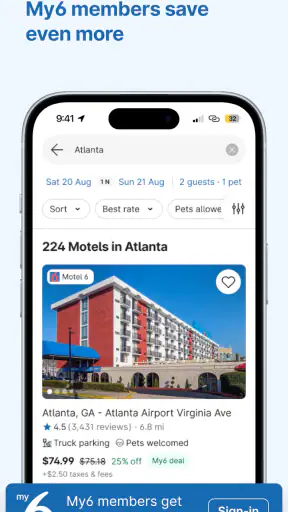
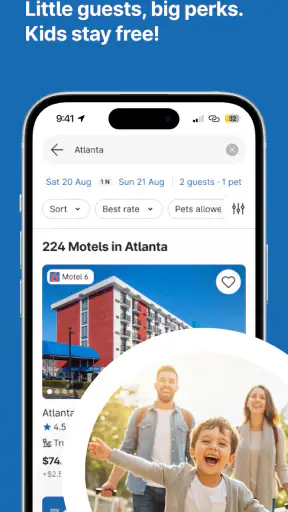
When I need a room quickly, I usually care less about browsing inspiration and more about getting from a search screen to a usable reservation without unnecessary detours. Motel 6: Book Hotels My6 Deals is built for that practical moment. It is a free Travel & Local app from G6 Hospitality LLC. that focuses on finding Motel 6 properties, comparing available stays, and using My6 offers during the booking process. After spending time with it, I see it as a focused tool rather than a universal hotel marketplace.
The most important thing to understand is that this is a connected booking companion. Its usefulness depends on current hotel information, account or reservation access, and the network connection available when you search. That makes it convenient before a trip and potentially frustrating in exactly the moments when a traveler is tired, driving through an unfamiliar area, or working with weak mobile service.
How the app feels when a trip is already in motion
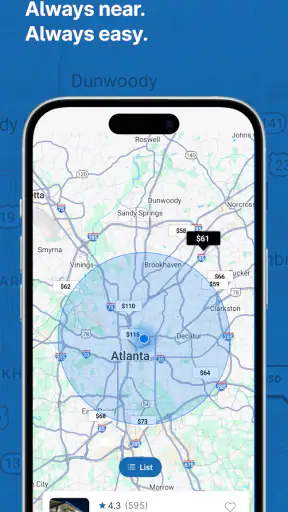
The app makes the most sense in ordinary travel situations: a late arrival, an unexpected overnight stop, or a road trip where I want to check a familiar budget-hotel brand before settling on a location. Instead of opening a broad booking marketplace filled with many chains, I can stay within the Motel 6 network and look for a nearby property. That narrower scope is both its strength and its main limitation.
For someone who already prefers Motel 6, the focused approach reduces visual noise. I am not comparing a large collection of unrelated brands, room styles, and loyalty programs. I am checking whether a suitable property is available and whether the My6 deal makes the direct booking route worthwhile. For a traveler who chooses primarily by neighborhood, amenities, cancellation terms, or review depth across many brands, a general hotel app will usually offer a broader decision-making workspace.
The app has been available since October 17, 2016, and its current version is 13.0.4. It supports devices running Android 7.0 or later, which gives it a reasonably broad reach among older Android phones. Its age rating is Everyone, so it is presented as a general travel utility rather than an app aimed at a restricted audience. I would still treat the phone itself as a travel tool: keep the operating system updated when possible, and avoid making a reservation while distracted in traffic.
Its reception suggests that many people find the focused booking experience useful. The app holds a 4.7 average from around 32 thousand ratings, with roughly 3.8 thousand written reviews, and it has passed one million installs. Those figures do not replace my own judgment, but they do indicate that the app has reached a substantial audience rather than being an obscure companion used by only a handful of travelers.
What happens when the connection is good
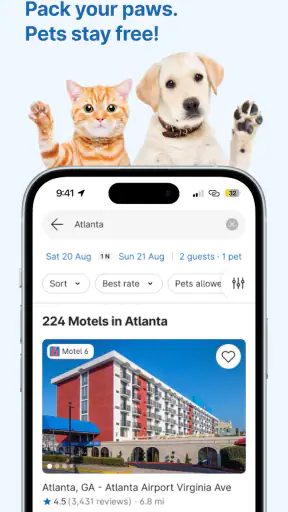
With a stable connection, the basic workflow is straightforward: open the app, search for a destination or property, review the available result, and continue toward booking. The experience is most comfortable when I already know the general area and dates. A clear plan means fewer searches, fewer map movements, and less time waiting for fresh results.
I found that the app rewards preparation. Before leaving home, I would search the destination, inspect the available options, and make sure the reservation details are correct while the connection is dependable. This is more than a convenience tip. It changes the risk profile of the entire trip because a reservation process that is easy on home Wi-Fi can become much less forgiving beside a highway with intermittent coverage.
My6 deals are the feature that gives the direct-booking route a specific reason to exist. If I am already considering a Motel 6 stay, checking the offer inside the official app is sensible before using a general booking service. The trade-off is that I should not assume the direct route will always be the best answer for every trip. A third-party hotel marketplace may show more brands, more room categories, or a wider range of nearby alternatives, even if the direct app offers a more relevant deal for this chain.
Using it in mobile contexts
The most realistic use case is not sitting at a desk with unlimited time. It is standing in a parking area, riding as a passenger, or stopping at a rest area after plans have changed. In those settings, small decisions matter. I would enter the destination before moving again, use the phone when safely stationary, and avoid repeatedly refreshing results just because a page takes a moment to load.
A traveler with a large phone and reliable service will probably find browsing comfortable. On a smaller screen, the practical challenge is reviewing dates, location details, and reservation information without rushing. I recommend slowing down at the final confirmation stage. A quick booking made on a phone is only helpful if the destination, arrival information, and selected stay are correct.
The app is also useful for a passenger helping with a group trip. One person can handle navigation while another checks a possible Motel 6 stay. That division is less about a special feature and more about using the app in a way that avoids unsafe multitasking. I would not use it as a reason to stop paying attention to road conditions or to let the driver manage a reservation while moving.
For families, the Everyone rating makes the app broadly approachable, but the booking decision still belongs to the adult responsible for the trip. Children may be able to understand the simple search purpose, yet they should not be left to enter payment or reservation information without supervision. The app is a travel utility, not a family itinerary manager, so I would pair it with whatever navigation and planning tools the group already uses.
When connectivity fails at the worst time
Connectivity is where the experience becomes less predictable. Searching for a hotel requires current information, and a reservation workflow is not something I want to improvise while a page is half-loaded. If service drops during a search, I would first stop repeating the same action. Repeated taps can make it unclear whether the app is still processing, whether the request failed, or whether a reservation step was submitted.
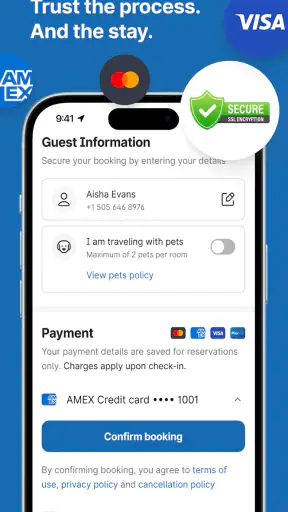
My preferred recovery routine is simple. I would wait for a stronger signal, check whether the app has visibly completed the previous step, and then review the reservation status before trying again. If I had reached a confirmation screen, I would avoid submitting a duplicate booking immediately. If I had not reached confirmation, I would restart carefully once the connection returned. This cautious approach matters more than speed because duplicate reservations or uncertainty about a completed transaction can create avoidable stress.
Weak service can also affect the discovery stage. A property may appear slowly, location searches may take longer, and changing dates or destinations can require another network request. I would therefore search while connected, save the important reservation details in a place I can access without reopening the app, and keep the property address available for navigation. That is a practical travel habit even when the app itself is working perfectly.
I would not treat the app as a replacement for a reservation record or as the only source of trip information. If I book before departure, I can capture the confirmation details for reference. If I am booking from the road, I would make sure the result is clearly confirmed before closing the app or driving away. The key distinction is between a search result and a completed reservation; they are not interchangeable.
Keeping mobile data use sensible
Hotel searching is not usually the heaviest task on a phone, but travelers may still be working with limited data, roaming service, or a congested network. I would avoid opening and closing the same search repeatedly, especially when the destination and dates have not changed. Entering precise information once is more efficient than browsing broadly and correcting the search several times.
Before a trip, I would use Wi-Fi to complete the research-heavy part of the process. That means checking the destination, comparing the relevant Motel 6 results, and reviewing the booking information before leaving. On mobile data, I would reserve the app for targeted checks rather than casual browsing. This workflow also reduces battery use because the phone spends less time waiting for pages and refreshing location-based results.
There is another useful trade-off here. A general hotel marketplace may require more browsing because it presents many brands and property types. Motel 6: Book Hotels My6 Deals can be more efficient when I have already chosen the chain. If I have not chosen a chain, the narrower catalog may save data and attention but can also hide a better-fitting alternative elsewhere. I would decide first whether brand loyalty or broad comparison matters more for that particular night.
For travelers using an older Android phone, the minimum requirement of Android 7.0 is reassuring, but compatibility alone does not guarantee a smooth trip. Older devices may have less storage, weaker batteries, or slower performance under poor service. I would update the app before departure if an update is available through the normal store process, then test the sign-in and booking flow while at home rather than discovering a device problem after arrival.
Where the direct app beats the usual alternatives
The clearest advantage is concentration. If I want a Motel 6 stay, I can go directly to the brand’s booking environment instead of filtering a broad marketplace over and over. The My6 deal focus gives the app a purpose beyond simply displaying hotels. It is particularly appealing to repeat guests who already know what they want and prefer a direct relationship with the chain.
Direct booking can also make the search feel less cluttered. I am not weighing an endless list of unrelated properties when the decision has already narrowed to Motel 6. That can be valuable during a last-minute stop, when speed and familiarity matter more than exploring every possible accommodation.
However, the usual alternatives remain better in several situations. If I need to compare Motel 6 with independent hotels, hostels, vacation rentals, or other budget chains, a broad travel marketplace gives me more context. If I care about neighborhood walkability, distinctive amenities, or detailed cross-brand review comparisons, I would start elsewhere and use this app only after identifying a Motel 6 property worth checking.
Maps can also be a better first tool when the main question is geographic: how far the hotel is from an airport, whether it sits along the route, or how it relates to a meeting location. I would use a map for spatial planning and this app for the direct Motel 6 booking step. Neither tool completely replaces the other.
Who should use it and who should skip it
I would recommend it to travelers who regularly choose Motel 6, want to check My6 deals, or need a focused way to look for a stay without comparing every hotel brand in town. It is also a reasonable backup for road trips where plans may change and a familiar chain is preferable to an unknown property.
I would be more cautious recommending it to someone who wants one app to manage an entire trip. Its purpose is hotel booking, not comprehensive itinerary planning. A traveler who needs flights, rental cars, restaurant reservations, transit directions, and broad accommodation comparison will likely be better served by combining several specialized tools or using a larger travel marketplace.
I would also skip it as a first choice if the destination has limited Motel 6 coverage or if the group has strict requirements that need broad filtering. In those cases, starting with the brand’s app can create a false sense of choice. It may show a convenient option, but the best overall stay could belong to another chain or a different type of lodging.
Small habits that make the booking safer
- Search before the trip begins: use a reliable connection to check the destination and dates, especially if you expect to travel through areas with inconsistent service.
- Separate searching from confirming: a property result is not the same as a completed reservation, so I review the final details before leaving the confirmation screen.
- Keep a backup record: save the important reservation information where it can be consulted without repeatedly reopening a live search.
- Use the right tool for the question: check a map for route planning, a broad marketplace for cross-brand comparison, and this app for a direct Motel 6 search and My6 deal check.
- Avoid duplicate attempts: after a connection interruption, I verify what happened before submitting the same booking again.
These habits are especially useful because the app’s convenience comes from live connectivity. The same connection that makes current searches possible can become a weakness when coverage is poor. Planning around that reality gives the app a more dependable role without expecting it to solve every travel problem.
My final view after using it
Motel 6: Book Hotels My6 Deals is a sensible, free option for a specific traveler: someone who wants Motel 6 and values a direct path to available stays and My6 offers. I like its focused purpose, and I can see why it works well for repeat guests and last-minute road-trip decisions. The app is easiest to appreciate when the brand choice has already been made.
My reservation is not about the idea behind it but about the boundaries of that idea. It is network-dependent, narrower than a full hotel marketplace, and less useful when I need to compare many accommodation types at once. A weak signal can turn a quick booking into a sequence of uncertain taps, so I would prepare important details before traveling and keep a backup record of the reservation.
Overall, I would install it if Motel 6 is already one of my preferred lodging choices. The 4.7 average and more than one million installs show that it has broad appeal, while the current 13.0.4 release keeps it relevant for supported Android devices. For a traveler seeking every possible hotel option, I would choose a broader service first. For a traveler seeking a straightforward Motel 6 search with access to My6 deals, this app earns a place on the phone.


